Doghe Latine
3-layer pre-finished panel
The new project by ITLAS has been created to combine the timeless elegance of wood with the most advanced engineering performance. A parquet floor where every single plank is the result of a three-layer architecture, meticulously detailed to offer an extraordinary tactile and visual experience, without compromise. Thanks to its special structure, Doghe Latine guarantees balance, long-term stability and acoustic comfort.
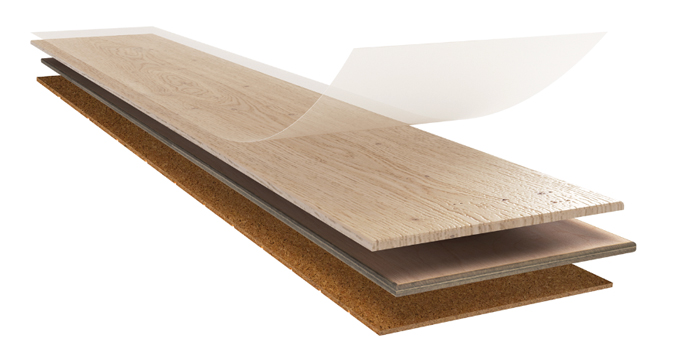

Thickness 3,5 mm ±0,5

Cork has low thermal conductivity and is therefore an excellent natural insulator that acts as a sound absorber, drastically reducing impact noise and improving thermal insulation by minimising heat loss and thermal bridges, enhancing comfort in winter and limiting peaks in indoor temperature during the summer. Incorporated, as is the case with ITLAS’s Doghe Latine range, into the parquet ‘package’, cork is therefore a completely natural and sustainable insulator. It acts as a mat integrated directly into the parquet, releasing no volatile organic compounds and ensuring a life cycle with low environmental impact.
In the impact sound insulation test, the Doghe Latine flooring achieved a ΔLw of 15 dB.
The Doghe Latine parquet flooring is classified as fire reaction class Cfl-s1
Cork is a natural material that is resistant to mould, fungi and insects. It also shows minimal deformation over time, which means it retains all its performance characteristics in the long term. Naturally waterproof thanks to the waxy substance coating its cells, cork is also resistant to water absorption and does not lose its insulating properties when exposed to damp.
Doghe Latine offers all the benefits and features of a pre-finished wooden floor by ITLAS. From the craftsmanship of the manufacturing techniques to the components used in the production of the parquet, all of which comply with the company’s quality and environmental policy, as well as its principles of ethical and social responsibility.
The ‘Doghe Latine’ finishes


The ‘Doghe Latine’ finishes
Cork is a plant tissue that covers the stem and roots of woody plants, where it replaces the epidermis, which is torn away by secondary growth. It is formed of cells arranged regularly and precisely in overlapping rows, with no gaps between them. Their secondary cell walls consist of alternating layers of suberin – an essential component of cork, which determines its main characteristics – and waxes. Once mature, the cells die and the cell walls are replaced by air, which enables cork to act as a thermal insulator.

Environmental sustainability
The combination of technical performance, natural origin and renewability make this plant-based fabric a material that is consistent both, more generally, with the decarbonisation of the construction sector and with the development of sustainable architecture – which has led to an ever-increasing use of natural materials to ensure environmental sustainability, comfort and the healthiness of indoor environments – as well as with ITLAS’s decision to invest in sustainable research projects, and thus in sustainable solutions. It is, in fact, a material harvested cyclically by gently removing the outer layer of the stem on average every ten years. This timeframe allows the plant to completely regenerate its outer layer. This system, known as debarking, is considered a virtuous supply cycle and an excellent example of sustainable forest management. And thus of the circular economy.
Environmental sustainability
Write to us for more information
Fill out the form adding your request and we will contact you as soon as possible.
